
News
AEB Sustainability Committee Open Meeting on Material Topics in Sustainability Reporting
16.04.2026
On April 16, 2026, the Sustainability Committee of the Association of European Businesses (AEB) held a public event on non-financial (sustainability) reporting, with a focus on the determination of material topics for such reports.
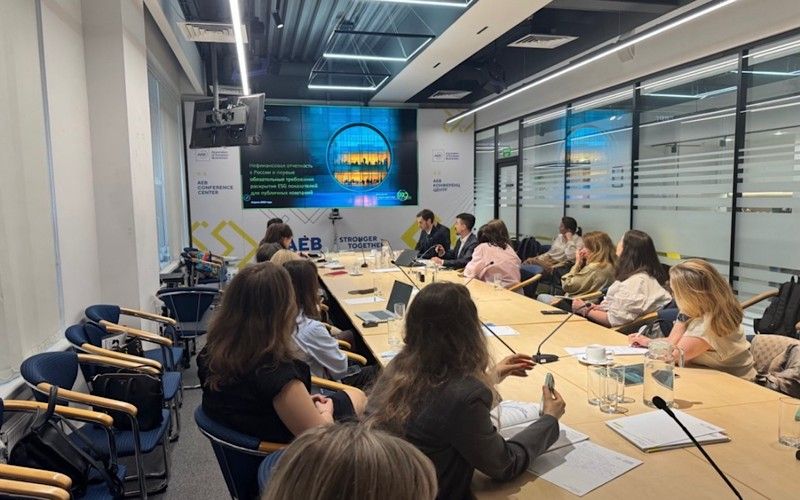
The event featured presentations from:
1. Vladimir Gorchakov, Head of ESG Risk Assessment Group at ACRA;
2. Ivan Topolya, Chairman of the Committee on Integrated Reporting;
3. Timur Tursunov, Partner, Sustainability Services Group at DRT;
4. Maria Kalinovskaya, Director, Operational Risk and Sustainability Group at Kept;
5. Timofey Lukashevich, Associate in the Corporate Practice at Melling, Voitishkin & Partners.
The event was moderated by Roman Ishmukhametov, Chairman of the AEB Sustainability Committee and a Senior Associate at Melling, Voitishkin & Partners.
Key takeaways from the meeting:
1. Russian law, including stock exchange requirements, imposes mandatory non-financial disclosure requirements on public companies and provides recommendations for a broader range of businesses.
2. Global frameworks for non-financial disclosure are outlined in thematic and industry-specific standards issued by standard-setting bodies such as the Sustainability Accounting Standards Board (SASB), the Global Reporting Initiative (GRI), and the Task Force on Climate-related Financial Disclosures (TCFD), among others.
3. In Russia, approaches to non-financial disclosure have been established by the Bank of Russia, the Ministry of Economic Development, the Government, and stock exchanges. The Standard on Business Social Capital (SBSC), approved by the Government, is becoming a key document in this area.
4. Regardless of regulatory obligations, such disclosure is a critical business practice, including for non-public entities and Russian subsidiaries of international companies. This is especially relevant given the growing demand from government authorities for an assessment of a company's contribution to Russia's socio-economic progress, including its national development goals.
5. The first step in preparing a non-financial report is to identify material topics related to (i) the company's impact on society and the environment, and (ii) the reciprocal impact of social, environmental, and other factors on the company. It is best practice to determine these topics at the beginning of the reporting year.
6. The most common material topics for companies include, among others:
- Environmental protection, climate change, and energy efficiency;
- Occupational health, industrial safety, and employee development;
- Engagement with regions and local communities;
- Economic performance and sustainability;
- Business ethics and anti-corruption measures.
7. Non-financial information can be included in an annual report, a separate sustainability report, a corporate social responsibility (CSR) report, or another report of a similar nature. Specific information may also be disclosed through other channels, such as notices of material facts.
8. When disclosing any non-financial information, it is crucial to formulate it with maximum clarity and ensure it is legally sound. Companies should also obtain sign-off on the disclosure from relevant business departments and secure approval from corporate governing bodies, in a manner analogous to the approval process for financial statements.
Share:


 Get it on
 Download on the
Login
You are successfully registered